
HOME / SERVICES / IMPLANTOLOGY
IMPLANTOLOGY
Implantology is a branch of dentistry that deals with the placement of implants to replace lost teeth, improve the function of chewing and speech, and achieve the best possible aesthetics. Implants are the best replacement for lost teeth, as they replace and perform the function of the natural tooth root that has been lost.
What is an implant and what are its advantages?
A natural tooth consists of two anatomical parts: the crown (the part of the tooth we see in the mouth) and the tooth root (the part located in the bone). Implants are the best replacement for lost teeth, performing the function of the natural root. They can replace one, several, or all teeth in the jaw. As such, they optimally support ceramic crowns and bridges, enabling you to talk, chew, and smile with confidence.
The benefits of implant restoration are numerous:
- Preservation of bone after tooth loss
- Even distribution of forces during chewing function
- The feeling of having a natural tooth
- Preservation of adjacent teeth
- Creation of a fixed or semi-fixed prosthetic work instead of a removable denture
- Highly aesthetic prosthetic solutions contribute to a better overall appearance of the face and smile
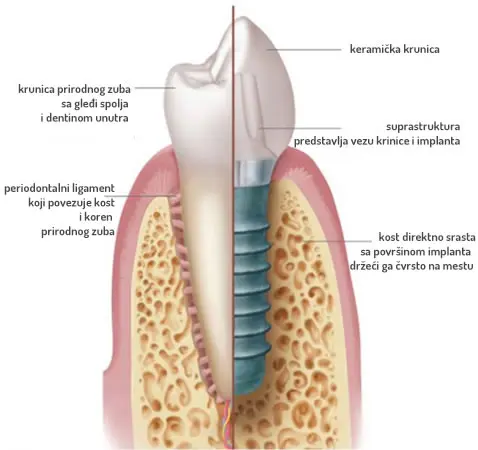
(image provided for use with the consent of Straumann®)
The most commonly used material for making implants is titanium, which, through decades of experience and research, has proven to have the best properties for osseointegration with bone. Straumann implants have 99.9% titanium purity. An important part of every implant is also the holder of the prosthetic part – the suprastructure (abutment), which in the Straumann® system is made of the highest quality titanium. The functionality of Straumann® innovations makes products and treatment methods achievable on the most advanced
principles.
Today, the success rate of implant placement is about 97% in the lower and about 95% in the upper jaw. An implant is considered successful if it lasts at least 15 years in the patient's mouth.
In cases where bone augmentation is needed, we use the highest quality artificial bone substitute (BioOss) and a guided regeneration membrane (BioGuide), produced by the Swiss company Geistlich® ( http://www.geistlich-pharma.com/en/ ).
Which implants do we use?
At the dental clinic “Dr Marković” we work with the 2 highest quality world implant systems: Straumann® (Switzerland www.straumann.com ) and Nobel Biocare® (Switzerland www.nobelbiocare.com ).


The Swiss company Straumann® is a world market leader in implant manufacturing. That is exactly why the largest number of published scientific research papers exist on Straumann® implants. More than 20 years of clinical research have resulted in a uniquely designed implant system confirmed in clinical practice according to the highest standards of modern dentistry.
It is also very important to note that with each placed Straumann® implant you also receive an implant passport, which records the unique reg. numbers and data of each placed implant, guaranteeing their authenticity. With a completed implant passport and control radiographs, the company Straumann® gives you a lifetime warranty on the placed implants.
Implant placement process:
The first step towards your new smile will begin with an examination and detailed analysis of a high-precision 3D scan (Sirona Galileos) of the jaws, which you will have done at our clinic. After the analysis, the implant placement plan is defined, along with the prosthetic solution that would best suit your case, as well as the dynamics of the entire process from implant placement to the finished prosthetic work. The implant is placed at the next visit.
Implant placement is a completely painless and simple procedure for the patient, performed under local anesthesia. Once the local anesthesia takes effect, the implant site is prepared, then the implant is placed and a few sutures are applied.
After the procedure is completed, the friendly staff of the “dr Marković” clinic will give you all the necessary therapy. In addition to the therapy, you will receive written and oral instructions to follow until the stitches are removed. The stitches are removed between the fifth and seventh day after the procedure. At your request, we can place resorptive sutures that will completely dissolve within 2 weeks, so you will not need to come for their removal.
All instructions are aimed at achieving your optimal and worry-free recovery.
Recovery and osseointegration of the implant:
Postoperative recovery is easy and without discomfort that would prevent you from carrying out your daily activities and obligations. The next day you can normally go to work, for a walk, and so on. What is not recommended is engaging in physical exertion for 5-7 days after the procedure.
An implant usually requires a period of 6 weeks to 6 months to osseointegrate with the jawbone. To help the patient get through the period without teeth until the fabrication of the definitive crown or bridge (especially if it is the smile zone), a temporary complete denture, partial denture, temporary bridge, or crown can often be made, depending on the region and the individual case.
After the osseointegration period, the implant is uncovered, impressions are taken, suprastructures (abutments) are placed, and definitive crowns or bridges are fabricated.
Check-ups after implant placement are performed every 6 months during the first year, and once a year thereafter.
Is it possible to place implants if there is not enough bone mass initially?
When there is not enough bone at the planned implant placement site, depending on the case, there are 3 procedures that can increase the bone mass.
They are:
- Augmentation (replacement) of the jawbone ridge with artificial bone substitutes
- Sinus lift (raising the floor of the maxillary sinus)
- Autologous bone graft
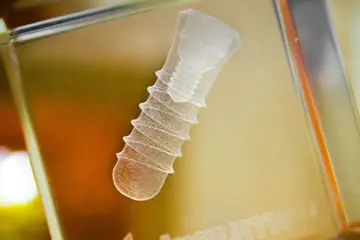
IMPLANTOLOGY
Implants are the best replacement for lost teeth, as they replace and perform the function of the natural tooth root that has been lost.
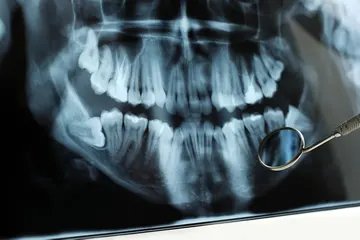
ORAL SURGERY
Oral surgery, in addition to tooth extraction (routine and surgical), includes a range of services that are very important in dental practice.

PROSTHODONTICS
In our clinic, for impaired chewing function caused by the loss of a smaller or larger number of teeth, we use modern methods of oral cavity rehabilitation.
TOOTH DISEASES & WHITENING
Tooth restoration with composite materials (white fillings) is a modern method for treating teeth affected by decay, as well as minor crown fractures.
ORTHODONTICS
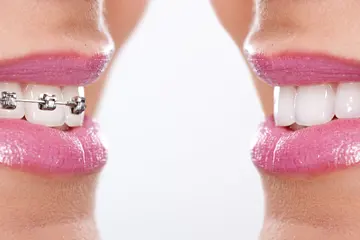
The clinic produces removable orthodontic appliances, functional orthodontic appliances, as well as metal and ceramic fixed appliances.

PERIODONTOLOGY
The goal of periodontal disease therapy is to eliminate pathological changes in tissues, eliminate subjective symptoms, ensure good function of teeth and supporting structures, and prevent further progression of the disease.